
Uprising
HVAC Surveying and Engineering
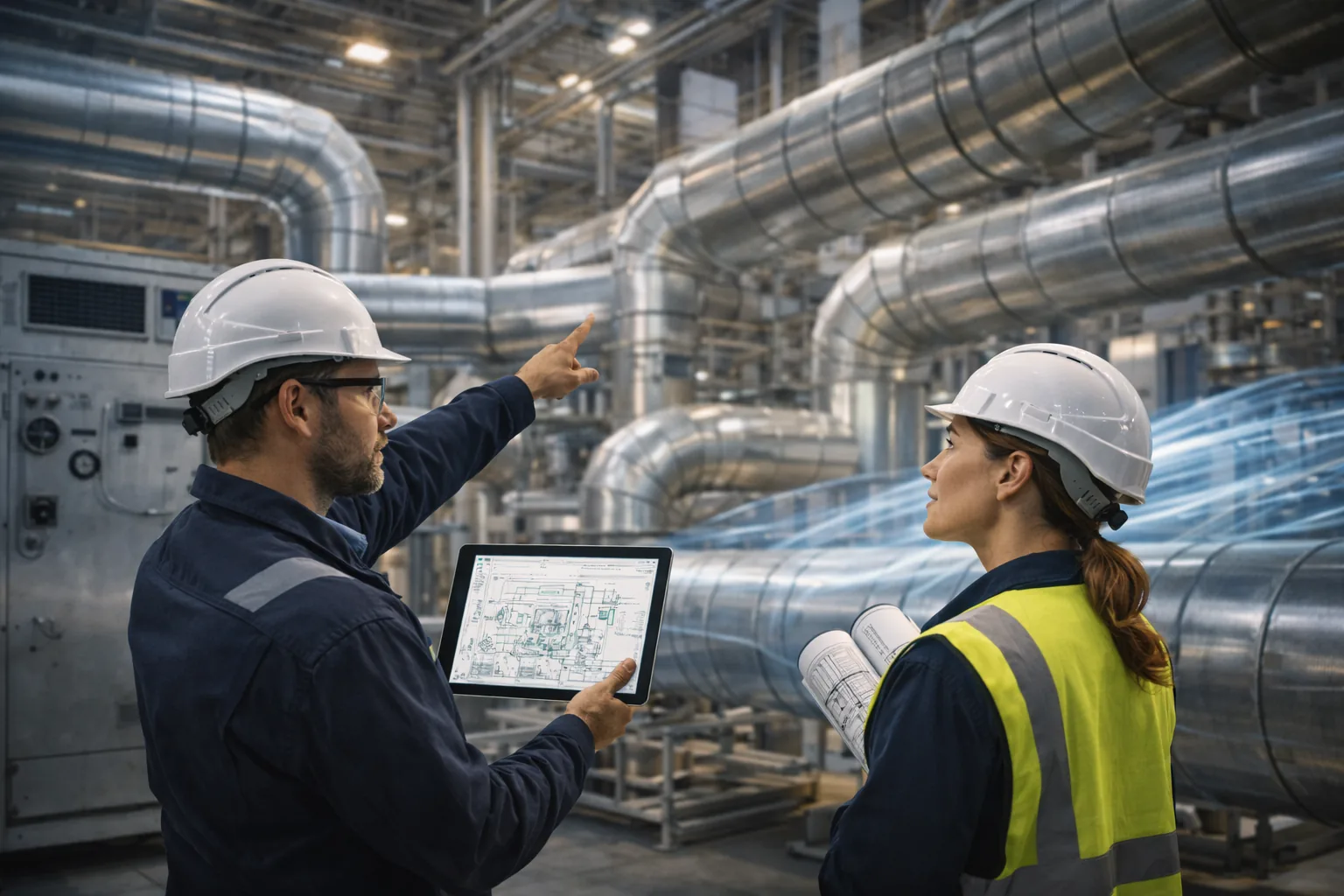
Field survey to develop the engineering of the HVAC system.
Engineering, technical supply and installation of industrial air conditioning and ventilation systems for temperature control, air quality and operational continuity.
In pharmaceutical, electronics, paint and data rooms, variations of ±2°C can cause batch rejections, product loss or equipment failure. An oversized or poorly controlled HVAC system is just as risky as an undersized one.
Chillers and controllers represent 30-50% of industrial electricity consumption. Without variable frequency drives in pumps and fans, or free-cooling strategies, the real EER of the system remains far below the potential of the installed equipment.
Condenser fouling, refrigerant degradation, and compressor failures can be anticipated with continuous pressure and delta-T monitoring. Without HVAC SCADA, the diagnosis is made post-failure when the cost is already four times higher.
We integrate end-to-end industrial HVAC with field survey, design and specification to ensure thermal stability and operational continuity.
Field survey to develop the engineering of the HVAC system.
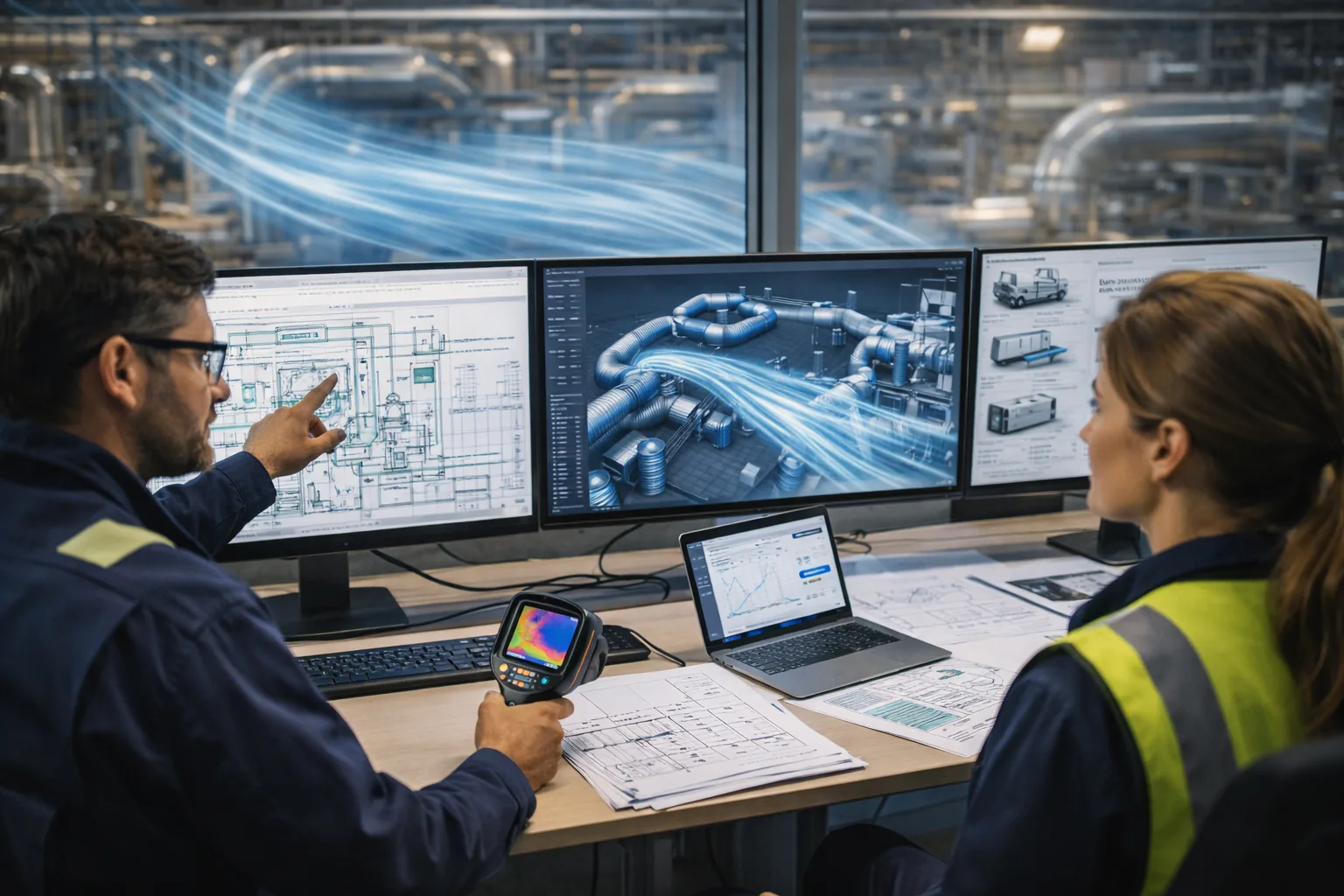
Technical definition and specification of air conditioning and ventilation equipment.
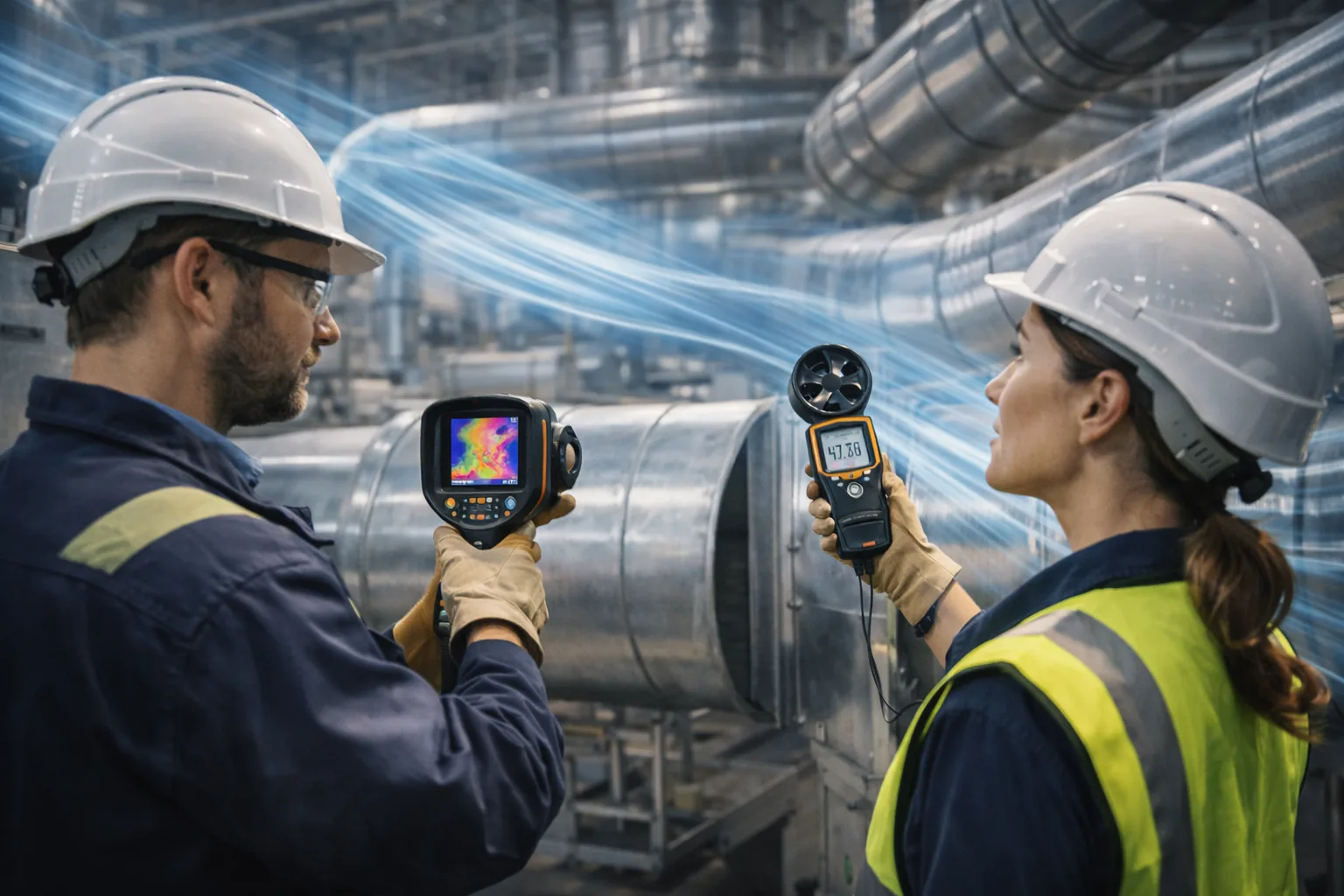
Provision of HVAC equipment, on-site installation and documented commissioning.


Field survey, design and specification, supply and installation with technical opinion and maintenance.
Industrial HVAC applications in environments with high operational demands and strict regulations.
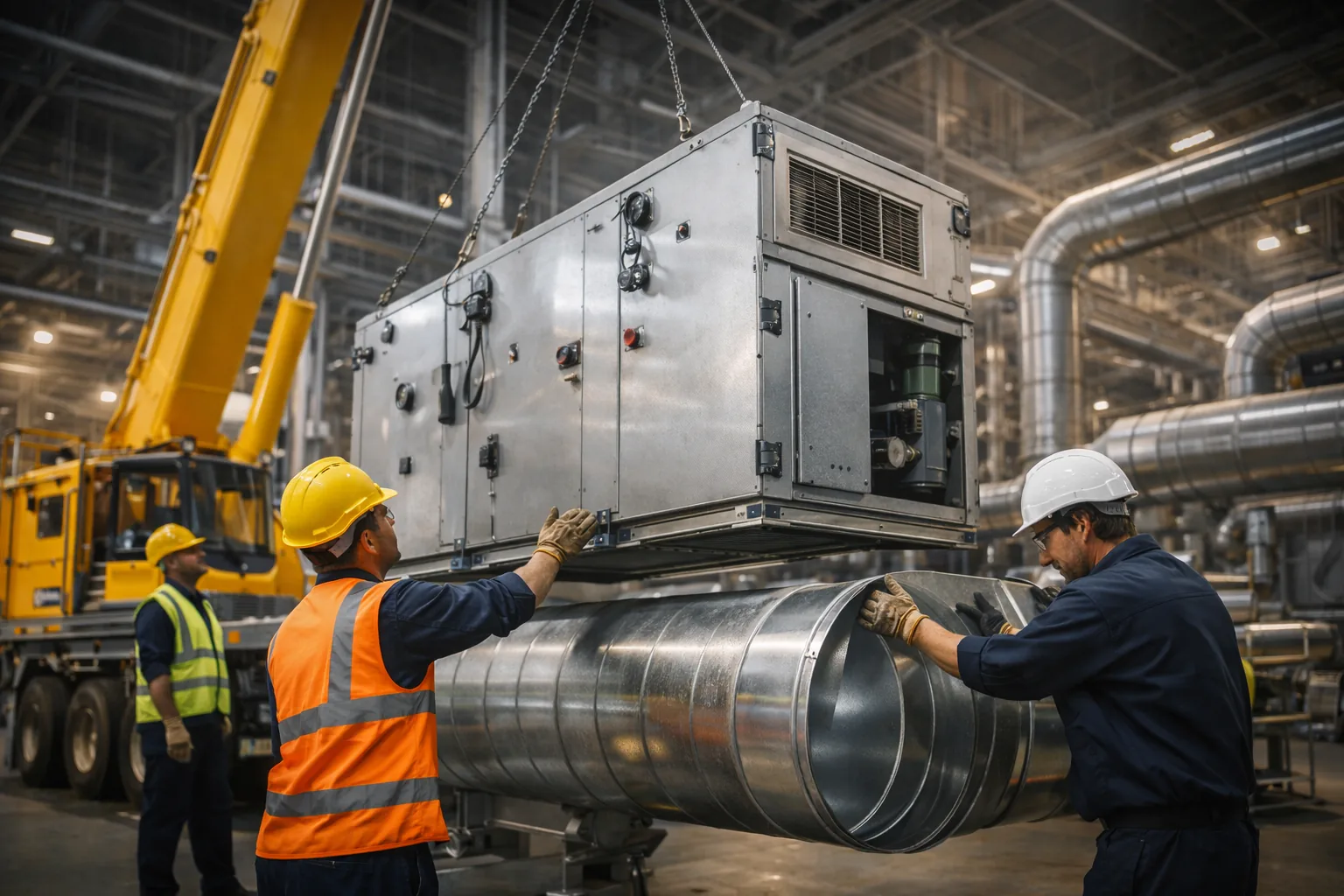
Provision of HVAC equipment type 5 TR horizontal integral package for specific environments (katal-C7, PEMEX, Campeche, 2023).
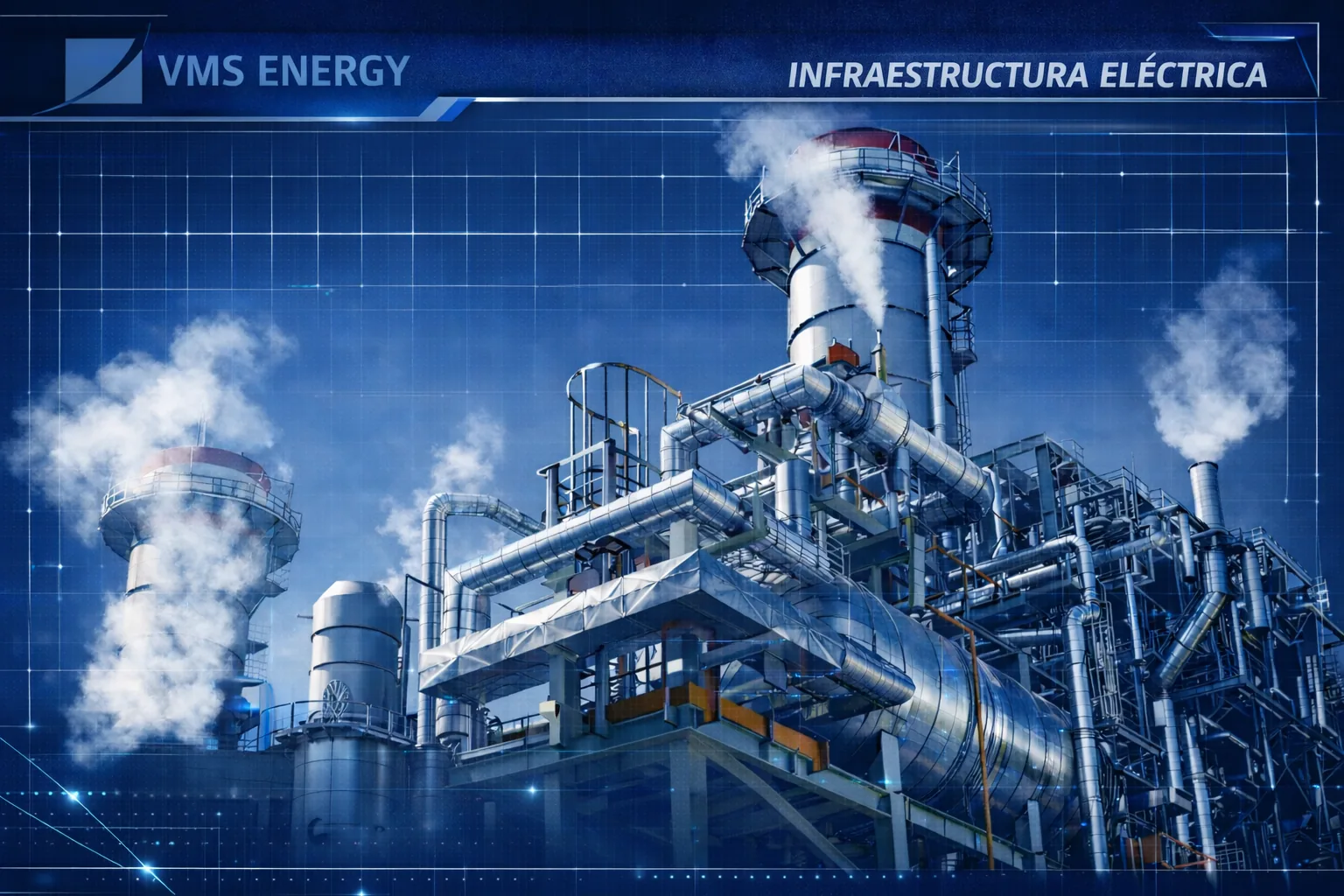
Air renewal and thermal extraction for critical equipment.
Thermal stability and particle control for continuous operation.

The ASHRAE CLTD/CLF method is applied: heat gains are added by envelope transmission (U×A×CLTD), solar radiation (SC×A×SHGF×CLF), lighting, occupants (≈70 W sensitive + 45 W latent/person), process equipment and ventilation. The result in BTU/h is converted to tons of refrigeration (1 TR = 12,000 BTU/h = 3.517 kW). We use ASHRAE 0.4% design conditions: Guadalajara 33 °C, Monterrey 40 °C, CDMX 27 °C, Ciudad del Carmen 35 °C.
Industrial HVAC handles much higher internal loads—machinery, exothermic processes, corrosive vapors—and must meet process air quality requirements: cleanliness, controlled relative humidity, and differential room pressurization. The equipment is heavy-duty (screw or centrifugal chillers, high static pressure handlers) and is integrated with the plant BMS/SCADA through protocols such as BACnet (ASHRAE 135) or Modbus TCP.
Current projects mainly specify R-410A (GWP 2 088) and R-134a. R-22 is being phased out under the Montreal Protocol. The Kigali Amendment (in force in Mexico from 2022) promotes the transition towards R-32 (GWP 675), R-454B (GWP 466) and ammonia (NH₃) in large-scale industrial refrigeration. We evaluate the optimal refrigerant according to capacity, availability of certified technicians and project life horizon.
The lower density of air at higher altitudes reduces equipment capacity by approximately 1% for every 300 m above sea level. In Mexico City (2,240 m) a chiller of 100 nominal TR delivers about 92.5 real TR. VMS Energy applies manufacturer correction factors and ASHRAE tables to ensure the selected equipment meets the calculated load at the actual site.
It is a formal document that evaluates the current state of the system: real capacity vs. demanded load, condition of compressors, coils and cooling towers, closed circuit water quality, and compliance with NOM-023-ENER-2010 and NOM-031-STPS. It is required before expansions or modernizations, for ISO 50001 certifications or when problems with temperature, humidity or abnormal energy consumption are detected.
We implement integration through BACnet IP / MS/TP (ASHRAE 135) for modern controllers, Modbus RTU/TCP for legacy equipment and LonWorks as required. Typical points include supply/return temperature, differential pressure, compressor status and kWh consumption. The integration allows centralized control, trend historicization, early alarms and savings strategies such as chilled water temperature reset according to partial load.
The process begins with a field survey—or review of plans in the EPC stage—to define areas and uses, process loads, site meteorological data and air quality requirements. With this information we prepare the ASHRAE calculation report, the conceptual engineering and the technical-economic proposal. The typical time for a firm proposal is 5 to 10 business days. Share your requirement in the contact form to schedule the survey.
Filter by category and quickly find the right service for your project.
We did not find services with these filters. Try another category or keyword.
Industrial HVAC lives between two extremes: large motors with drives and delicate process sensors. Without shielded EMC cable, a chiller's drive can inject noise into the temperature control loop of the neighboring cold room and put product at risk. We supply the three cable families that cover the HVAC chain integrated into the EPC scope.
LV/MV power cable for powering chillers, air handling units (UMA), refrigeration compressors and circulation pumps. Gauge per connected load and voltage drop limit — critical in plants with a long distance between the electrical room and equipment.
Shielded EMC cable for powering drive-controlled motors (VFD): variable speed chillers, cooling tower fans, pumps with BMS. The shield prevents common mode currents and protects bearings.
Shielded cable for RTD/Pt100 sensors, thermometers, humidometers, pressure probes and communication with the Building Management System. LSZH versions for cold rooms and areas with smoke-sensitive product.
We specify the power cable, EMC and control of the HVAC chain under the same technical criteria, we supply coordinated with the progress of the mechanical assembly of equipment and we deliver traceable documentation per coil. NOM-001-SEDE compliance and compatibility with common BMS platforms.
We review thermal conditions, scope and times to send you a technical proposal. We will contact you in less than 24 business hours; The proposal time depends on the scope.
AKAL-C7 Platform — Pemex
Campeche (offshore)
Provision of HVAC equipment type integral horizontal package of 5 T.R. for specific environments on marine platforms.
Infrastructure project — tunnel
State of Mexico
Integration and commissioning of 12 NEMA 12 cabinets with Siemens drives and Profinet control via SCADA for the ventilation and extraction jetfans inside the tunnel.
Protexa Group
Mexico
VMS Energy client in the oil & gas sector.
Weatherford
Mexico
VMS Energy client in oilfield services.
Holcim Mexico
Mexico
VMS Energy client in the cement sector.
Flextronics
Mexico
VMS Energy customer in electronic manufacturing.
GAM
Mexico
VMS Energy customer in food and beverages.