How long can you stop your process?
If the answer is zero milliseconds — you need an UPS. If the answer's minutes or hours — you need BESS. If the response is both — you need both working together.
We design, supply and install backup UPS and BESS energy storage systems for critical industrial facilities, from engineering through commissioning and maintenance.
Microcuts, voltage dips, frequency variations and prolonged interruptions are part of the industrial electrical operation in Mexico. The real impact is not measured in kilowatt-hours — it is measured in unplanned downtime, damaged equipment, lost production lots and unfulfilled contracts.
In sectors such as Oil & Gas, mining, food and beverage manufacturing, or energy generation, an outage of seconds can represent losses of hundreds of thousands of pesos and unacceptable security risks.
Not all backup solutions are created equal, and the wrong choice can mean costly oversizing or underprotection. At VMS Energy, the process begins with a diagnosis — not a catalog.
If the answer is zero milliseconds — you need an UPS. If the answer's minutes or hours — you need BESS. If the response is both — you need both working together.
If you have peaks of demand that trigger your rate, variable charges, or a high demand charge bill — strategic storage (BESS) usually generates return in less than 4 years, calculated with your own receipt. If your charges are constant and critical — industrial UPS is the backbone of your continuity.
If the answer is yes — storage turns your solar plant into a manageable, not intermittent source. The solar + BSS+network combination is the most efficient architecture for industry in Mexico today.
CFE industrial electricity rates are not just billing data — they are the map that indicates which technology generates the greatest return on investment for your facility.
Demand up to 25 kW/month. Commercial facilities and small services.
• Recommended ESS solution
Hybrid inverter + batteries · 5.2 – 100 kWh
Lawsuit more than 25 kW/month. Light industry and medium commerce.
• Recommended ESS solution
Hybrid inverter + batteries · up to 100 kWh
Until 99.99 kW In medium voltage. Manufacturing and medium industry.
• Recommended BESS solution
Industrial storage system · from 261 kWh
100 kW or more In half voltage with charges for time demand. Heavy industry.
• Industrial BESS solution — Maximum savings
Peak shaving + backup + solar · Typical return: less than 4 years
i If you do not know with certainty what rate your installation is registered, your CFE receipt indicates it in the “Rates” section. The VMS Energy team can help you interpret your demand profile and estimate potential savings — no cost, in 5 business days.
All three technologies solve the electrical continuity problem, but they do so in radically different ways. The wrong choice can cost you more than you save.
| Criterion | UPS Industrial |
BESS Industrial |
Diesel Generator |
|---|---|---|---|
| Response time | 0ms — without perceptible interruption | Milliseconds — almost instantaneous switching | 8–30 seconds — start-up + stabilisation |
| Typical autonomy | 10 min – 4 h (depending on battery bank) | 2 h – >10 h (scalable by modules) | Unlimited (as long as there is fuel) |
| CFE bill reduction | No — only protects, does not save | Yes — The peak demand is reduced by the peak demand of the peak | No — adds operating cost (diesel) |
| Solar/PV integration | Limited — requires separate inverter | Native — IEMS manages solar, BESS and network | Requires a controller that coordinates generator and inverters |
| Operating emissions | Zero emissions | Zero emissions | High — CO2, NOx, noise >85 dB |
| Annual maintenance | Low — batteries every 5–8 years | Very low — ≥8,000 cycles, no water maintenance | High — oil, filters, monthly tests |
| Ideal application | Critical loads that do not tolerate even 1 ms of interruption: PLC, control rooms, instrumentation | Loads that require extended autonomy + demand savings + solar integration. GDMTH rate. | Long-term backup where there is space and boot time is acceptable |
| Can be combined | ✓ Yes — VMS Energy designs hybrid architectures: UPS + BESS + Generator according to the criticality profile of each load. | ||
If your installation has loads with different levels of criticism — control rooms, production lines and auxiliary services — the correct architecture combines the three technologies into layers. See how layers are integrated into an availability architecture.
VMS Energy is not a distributor. It is the integrator who diagnoses need, specifies the solution, installs it and sets it up under a single contract. What follows is not a catalogue: it is the criterion with which we decide what suits each installation.
There are loads that do not support even one interruption cycle: control rooms, instrumentation, security systems and emergency stop. For them, the transfer has to be imperceptible, and the quality of the energy delivered stable even if the network is not.
How we decided:What we deliver: calculation memory, detail engineering, assembly, load testing and signed start-up protocol.
When the problem is not continuity but the bill, the objective changes: cut the peaks that set the demand charge and shift consumption outside of peak hours, without altering the production process.
How we decided:What we deliver: feasibility study with figures of the receipt itself, engineering, installation and subsequent measurement confirming the savings.
Photovoltaic generation is intermittent; the industrial process does not. Integrating it consists of converting a variable source into a manageable supply and leaving the interconnection in order.
How we decided:What we deliver: study of resource and incompetence, engineering of detail, civil and electrical works, interconnection and commissioning process.
Backup, demand management and own generation are installed on an internal network that must be prepared to receive them: voltage adaptation, coordinated protections, panels and pipelines that support the new operating regime.
How we decided:What we deliver: on-site survey, electrical studies, suitability, testing and closure file with plans of-146.
The choice of manufacturer and model is decided after diagnosis, never before. How we specify and supply is explained in Procurement and supply.
Before talking about kWh, we talk about security. The following functions exist in the industrial market, but not all come in all systems nor act at the same level– Actual scope depends on selected equipment and project conditions. VMS Energy establishes this scope in the detailed engineering and verifies it in commissioning.
A storage system is a layered set: switchgear live within a pack, the Williams inside the cabinet, and the cabinet inside its installation. The question that decides a purchase is not how many security functions it comes with, but at what layer each one acts. — that is, at what distance from the origin it comes to intervene.
Agent that acts without water and without damaging the electronics, with thermal threshold triggering and without human intervention. Depending on the system, the agent is housed within each pack or in a single tank for the entire envelope.
Acts at pack or cabinet levelMaintains indoor relative humidity above the dew point on switchgear, BMS and power electronics. Condensation is a common cause of premature failure in humid weather and intermittent operation.
Acts at cabinet levelDetects combustion particles before the smoke is visible and launches the first level alarm that triggers the ordered shutdown. The closer the detector is to the origin, the sooner the warning arrives: that is why it matters if there is one per pack or one per cabinet.
Acts at pack or cabinet levelContinuous temperature monitoring with alarm thresholds and automatic stoppage. Sensor density varies greatly between systems — from a few points per cabinet to several sensors per dozen switchgear — and it depends on how long there is to react.
Acts at the switchgear or pack levelGases released by a failing switchgear must be detected and evacuated before they accumulate. It is resolved with detection of combustible gas in the envelope, with unidirectional relief valves in each pack, or with both.
Acts at pack or cabinet levelVMS Energy documentally reviews the acceptance tests in the factory and executes the acceptance tests on site: failure simulation, alarm activation, all sensor testing and protocol signing with the customer before delivery. It is the verification that the specified is what was installed.
Acts at the installation levelBoth comply. The difference is what is confined when something fails: a module, or the entire cabinet.
Each module is an independent safety unit: its own suppression, its own smoke detector, dense thermal sensing and one-way relief valve. Detection occurs adjacent to the switchgear and the event tends to be confined to the module. It costs more and multiplies maintenance points.
A single set of detection and suppression for the entire envelope. Less maintenance points and lower initial cost. In return, detection occurs further away from the source, and what is confined is the complete cabinet, not the module that failed.
What tips the balance in each project:
Note for HSE managers — each standard at its level
None of these standards certify a loose part. Each one applies to a different level:
VMS Energy delivers the security descriptive memory as part of detail engineering, and verifies function by function in the FAT/SAT protocols prior to delivery.
The difference between an equipment supplier and an EPC partner is what happens before and after delivery.
On-site measurement: voltage variations, microcuts, harmonics and demand profile. The diagnosis defines the solution and the expected return. Without evaluation there is no proposal.
Sizing, topology selection, redundancy architecture, one-line diagrams, calculation memory and IFC documentation ready for approval and execution.
Purchase management with manufacturers, import logistics, reception and verification in the warehouse. For Borri and Sigenergy: verification of transport conditions and integrity of factory documentation.
Execution by certified crews: civil works if applicable, mechanical assembly, power and control connections. No unplanned production stoppages.
FAT/SAT tests: battery, transfer and bypass parameters, network failure simulation, switching times, alarms and communications. Protocols signed and delivered.
Preventive program frequently according to criticality: thermography, SOH tests, firmware, trend analysis. Annual contracts with guaranteed response times.
The price of a storage system is just the beginning. The Balance of System (BOS) represents between 30% and 40% of the total project cost — and is where the difference between an EPC integrator and a simple equipment provider becomes critical.
Low and medium voltage nozzles, distribution bars, maneuver switches and actuators. Design coordinated with existing installation.
Thermomagnetic switches, high-break fuses and surge protection devices (SPDs). Short circuit study and coordination of protections included.
Certified medium voltage cables, cable trays, rigid and flexible conduit. Sized according to NOM-001-SEDE and voltage drop calculation for large-scale BESS projects.
Concrete foundations and bases for BESS containers, storm drainage systems, access for maintenance and electrical room adaptations if the system is indoor.
Crane unloading, container positioning, mechanical and electrical integration, import logistics management. Crews specialized in high capacity systems.
Design and execution of the earth network in accordance with IEEE 80/IEC 60364: equipotential mesh, soil resistivity measurement, continuity and resistance test before energizing.
Supply of equipment, engineering BOS, civil works, permits to CFE and CENACE, and final commissioning. One sole responsible, one contract, no cost surprises in execution.
We publish the complete file of each project at closing. The projects already delivered are in the section Reference projects and clients.
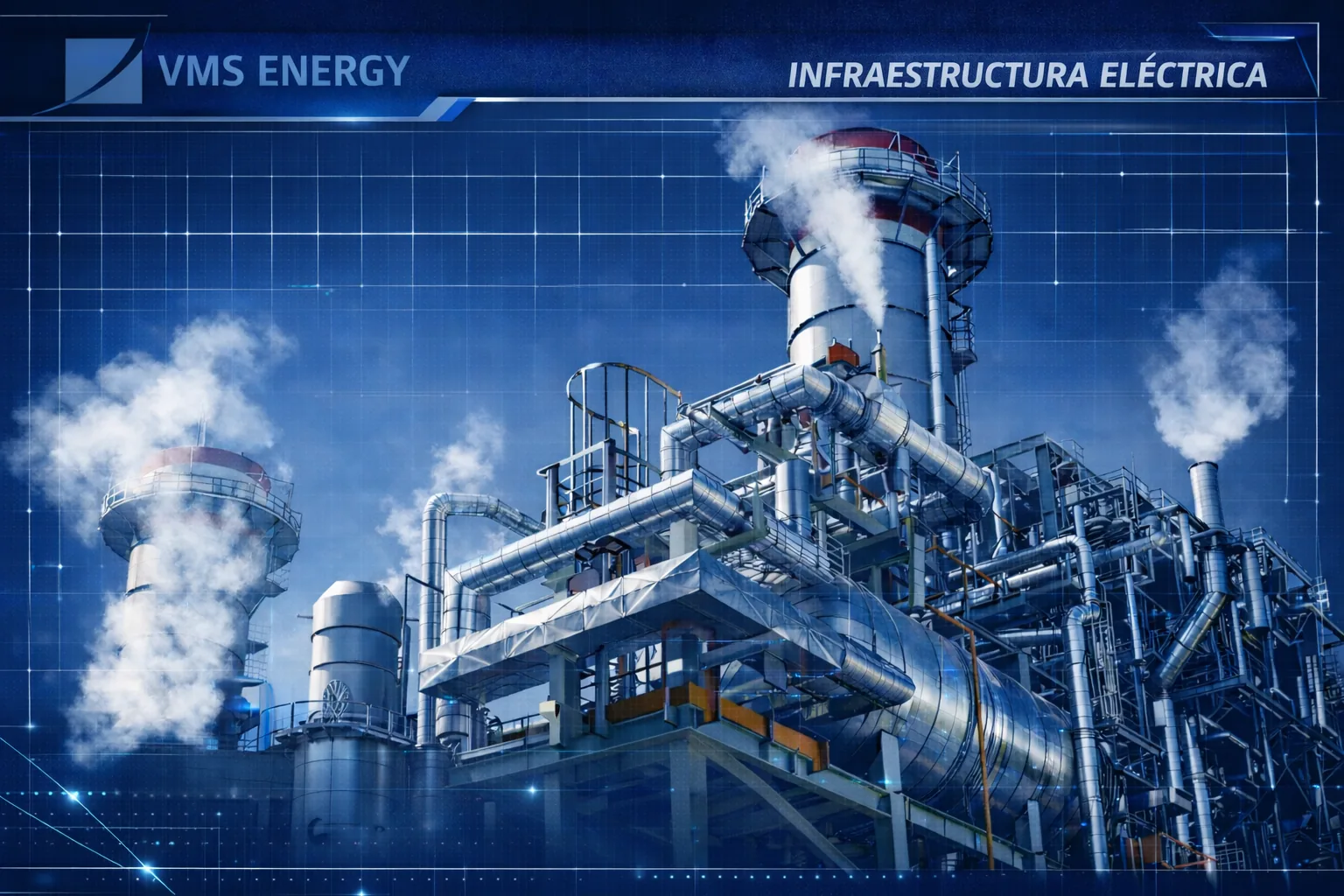
VMS Energy is currently running a project with industrial equipment from the Borri industry for facilities of the Federal Electricity Commission in Colima.
In highly demanding industrial sectors: Oil & Gas, mining, manufacturing and energy.
9001, 14001, 37001, 45001, 50001 — the contractor operating to world-class standards.
CFE, PEMEX, Baker Hughes, Coca-Cola, CEMEX and other critical operators in Mexico.
Borri (UPS, Legrand Group), Sigenergy (BESS modular), WEG — with multi-brand integration.
Integration with existing infrastructure: ABB, Siemens, Schneider, Rockwell.
Operations in Guadalajara and Ciudad del Carmen, with national coverage for projects.
The legal framework for BESS systems in Mexico involves four authorities with different powers. VMS Energy accompanies the complete regulatory process — from design to the procedures before each instance.
Defines the policy and planning of the electricity sector. The Electricity Sector Law (LSE, March 2025) and its Regulations (October, 2025) recognize storage as an activity within the National Electrical System, along with the Law on Planning and Transition of the Planet.
It replaced the CRE. It gives generation permissions from 0.7 MW and storage permissions when the system is from 0.7 MW or more and No is associated with a power plant or a charging center. behind the meter (behind-the-meter) is part of the user's charging center, which is the most common configuration in industrial projects of the "Corporate" of the "Mic" Series. A BESS that is part of a power station with generation permission does not require additional permission.
Manage the Support fee it applies when the BESS is integrated with its own generation (FV single) and the user requires network power at times of insufficiency. If the BESS system is interconnected to export surplus, it is formalised with a Medium or High Voltage Interconnection Contract. The rate paid by the user (GDMTH, GDMTO, etc.) remains the same — the BESS only reduces the billable charges. Generation less than 0.7 MW operates as distributed generation, with an interconnection contract and without permission from the CNE.
It operates the national electricity system and the wholesale electricity market. For BESS systems that actively participate in the market (arbitration, ancillary frequency regulation services), CENACE defines the technical enabling requirements and the dispatch protocol. In projects behind the meter (industrial BTM), CENACE's participation is indirect — the BESS system does not interact with the national office.
We identify which procedures apply to your project — in most BTM industrial cases, none before the CNE or CENACE. And when required, we coordinate the management at each instance without your team operating as a manager.
Technical answers on selection, sizing and integration of industrial UPS and BESS systems.
The norm IEC 62040-3 He ranks the UPS in three topologies. VFI (online double conversion) is the only one that provides total galvanic isolation and zero transfer time — it is the standard for Oil & Gas, mining and critical control rooms. VI (interactive) regulates voltage but bypasses during microcuts; suitable for less critical loads. VFD (standby) only acts when the network fails; valid for basic backup in offices. For industrial plants with continuous processes, VMS Energy exclusively specifies UPS VFI Borri E3001/E2001 because the load never sees the net directly.
Autonomy depends on the actual power of the load (kW, not kVA — cosφ must be applied), the capacity of the battery bank (kWh) and the efficiency of the inverter (92–96% in modern VFI UPSs).
VMS Energy-Draft the bank according to the backup time required by the customer's business continuity plan.
VRLA/AGM (sealed lead-acid): low initial cost, easy availability, but useful life of 3–5 years in frequent cycles, sensitive to temperature and low energy density (~30–50 Wh/kg). LFP (lithium ferrophosphate, LiFePO₄): ≥8000 life cycles, density 90–160 Wh/kg, operation from -20 °C to +60 °C, no memory effect, no maintenance. Our reference platform, Sigenergy SigenStack, uses 12 kWh LFP modules with security management at the pack level; Its UL 9540A and IEC 62619 tests are documented with Intertek. NFPA 855 is met in the design of the facility.
Peak shaving consists of downloading the BESS during demand peaks to reduce the maximum recorded in the CFE meter. In the GDMTH rate, demand charges (capacity and distribution) represent an important part of the bill, and the distribution charge varies greatly between divisions: in September 2026 it ranged from around 58 to 221 MXN/kW. A well-sized BESS can reduce the billed demand between 20% and 40%. With favorable profiles, the return is typically located below 4 years. We calculate it with your receipt and your measured load curve.
BESS standalone: when the objective is peak shaving, backup for CFE interruptions or frequency regulation. BESS + solar: optimal architecture when the plant has or plans photovoltaic panels — the BESS stores the midday solar surplus for use in the evening, eliminates curtailment and converts the installation into a semi-autonomous microgrid. With well-sized storage, self-consumption of solar energy increases significantly; We model it with its load curve before proposing capacity.
Data center UPSs are designed for controlled environments (18–24°C) with stable electronic loads. Industrial UPS Borri E3001 operate in extreme conditions: -10 °C to +50 °C, HR up to 95%, corrosive gases, dust, engine starters and THDi elevated by variable frequency drives. They include galvanic isolation by integrated transformer, protection up to IP54 and certified construction for classified areas. Using a data center in industrial plant is the most frequent source of premature failures by condensation, corrosion and Overvoltage not attenuated.
The process begins with an electrical survey: measurement of real load (kW and cosφ), recording of the demand curve in 15-minute windows for at least a week, inventory of critical vs non-critical loads and review of the history of interruptions. With this information we prepare the sizing engineering and present the technical-economic proposal with return analysis. Typical time for firm proposal: 5 to 10 business days. Contact us to schedule a free energy evaluation.
The rate GDMTH (High Hourly Medium Voltage Demand, applicable to installations with 100 kW or more) includes charges for maximum demand recorded in 15-minute windows. With a BESS correctly sized for peak shaving, the plant unloads the system during peak consumption hours, reducing the peak demand billed by CFE.
Illustrative example: A plant with a maximum demand of 500 kW and a base of 320 kW can cut its peak with a BESS of 180 kW. The savings depend on its tariff division, how many hours the peak lasts and whether it happens in peak hours, because the capacity charge is not linear. That is why we calculate it with your receipt and not with an average. The typical return for profiles of this type is located below 4 years.
The BOS (Balance of System) It includes all components external to the BESS equipment itself that are necessary for the system to operate safely, efficiently and connectedly. It does not include batteries, PCS or BMS — it includes everything that allows those equipment to function properly on site.
The BOS of an industrial BESS project includes: Electrical distribution (MV/LV switchgear, power switches), protection systems (protection coordination, SPD lightning rod), electric conductors (power wiring, trays, ducts), Civil works (foundation, electrical room or platform), maneuvers and installation (lifting, connection, testing), and grounding system (IEEE 80/IEC 60364 ground mesh). VMS Energy executes the complete BOS as part of the EPC scope — the customer receives the system ready to operate, not loose parts.
The Mexican electrical system operates through four regulatory layers which interact with each other and affect the installation of an industrial BESS:
An industrial BESS the-meter (behind the meter) is part of its load center: under the Electricity Sector Law it does not require a storage permit from the CNE. The technical installation standards do apply (NOM-001-SEDE, NOM-029-STPS, NOM-002-STPS) and, if it is integrated with its own generation, the interconnection contract or the corresponding permit depending on the capacity. VMS Energy manages technical and regulatory documentation as part of the EPC scope.
If you don't have the exact answer, that's precisely the starting point. Our engineering team conducts free energy assessments for industrial installations: we measure, analyze and determine precisely what technology solves your problem — and what is the expected return.
Electrical reliability does not end at the BESS or the UPS. These VMS Energy services work in synergy with your backup system:
P.SS. Chemul — Campeche Maritime Services / Pemex
Zonda de Campeche
Preparation of the electrical study to expand the battery banks with their respective chargers from three to six, under the rules of the Lloyd's classification house for electrical installations on board.
Abkatún-A and Maloob Platforms — Campeche Maritime Services / Pemex
Campeche (offshore)
Supply, pre-operational electrical testing, start-up and performance testing of a 10kVA Uzg and a line conditioner transformer, with a power bank of #295 Ah.
AKAL · Zonda — Campeche Maritime Services / Pemex
Campeche (offshore)
Manufacture, supply and pre-operational electrical testing of a photovoltaic system composed of photovoltaic array, charge control unit, power inverter, battery bank and distribution board.
Maloob-D, ZAAP-B and ZAAP-E platforms — Pemex
Campeche (offshore)
Electrical testing and commissioning of substations made up of Metal Clad distribution boards, 1,500 and 1,000 kVA transformers, 10 kVA UPS and 100 A battery charger.
BALAM-TD Platform — Pemex
Campeche (offshore)
Supply, installation, testing and operation of a 10-kVA uninterruptible power unit (UPS).
Cotemar
Ciudad del Carmen, Campeche
Engineering, supply, installation and commissioning of a 5 kVA three-phase UPS for a marine platform project.
Cantarell Nitrogen Plant (LINDE)
Villahermosa and El Salto, Jalisco
Specialized maintenance service for Hyundai 2 560 HP and 600 HP squirrel cage type engines.
Weatherford
Mexico
VMS Energy client in oilfield services.
GAM
Mexico
VMS Energy customer in food and beverages.