
Article Contents
- Executive Summary
- Mining Applications Where VFD Generates Greater Value
- Drive Selection Criteria for Mining
- How to select a drive for mining
- Typical Drive Architecture in Mining
- Key Technical Challenges
- Common Mistakes and How to Avoid Them
- Mini Reference Case
- SEO and Conversion Findings
- Technical FAQ
Executive Summary
The Frequency changers in mining (VFD mining or mining drives) have become one of the technical levers with the greatest impact on operational continuity, energy efficiency and process control. In extraction, crushing, grinding, pumping and venting operations, controlling speed, torque and starting ramp can mean the difference between a stable line and a plant with frequent shutdowns.
When evaluating a project motor control in mining, the drive should not be seen as an isolated piece of equipment. It must be analyzed as part of a complete electrical architecture: motor, mechanical load, network, protections, environment, control and maintenance strategy. This comprehensive vision is key to avoiding costly oversizing or undersizing that compromises reliability.
In mining, the operational demand is particularly high: constant torque loads, overload peaks, demanding electrical networks, dust, vibration and high altitude locations. Therefore, the variable frequency drives for conveyor belts, pumps, fans and mills require much more robust technical specification criteria than in conventional industrial applications.
This article summarizes how to select and apply VFD in mining with a practical approach: where they generate the most value, what criteria to use to choose them, what typical architecture is right, what are the most common errors and how to structure an implementation route that improves availability and reduces total cost of operation.
Mining Applications Where VFD Generates Greater Value

Frequency inverters have their greatest return when applied to loads with variability, controlled ramps and high availability requirements. In practice, the applications with the best technical and economic potential are usually:
- Conveyor belts: Transporter belt variable frequency drives reduce mechanical forces in start, minimize slips and improve section synchronization.
- Process and drain pumps: allow adjusting flow and pressure according to real demand, cutting consumption and hydraulic shocks.
- Main and auxiliary ventilation: enable fine air flow control, essential for safety and compliance with working conditions.
- Mills and crushing: improve low-speed torque control, especially in start-up and transient operation sequences.
- Critical auxiliary systems: like agitators, filtration or pumping tailings, where dynamic control protects equipment and maintains process quality.
In all these cases, a correct approach to Mining drives helps reduce current peaks, stabilize the internal plant network and protect mechanical assets. The result is not only energy savings: also improved reliability, less cyclical maintenance and greater operational neurability.
Drive Selection Criteria for Mining
Correctly choosing a drive in the mining industry requires a technical decision matrix and not just comparing nominal power. The recommended criteria are:
- Actual load profile: constant, variable or mixed torque; start/stop cycles; overload time.
- VFD Overload Capacity: especially critical in high inertia mills and conveyors.
- Control strategy: scale, vector or advanced control, according to required precision and dynamics.
- Environmental conditions: dust, temperature, humidity, vibration and level of contamination.
- Site altitude: consider derating, cooling and insulation for operations above 2000-4,000 msl.
- Power quality: Ironics, power factor, filters, network compatibility and transformer.
- Maintainability: access to spare parts, remote diagnosis, parameterization and field support.
From a perspective of energy efficiency mining, the best projects are those that integrate equipment selection, control strategy and commissioning into a single roadmap. Without this integration, it is common for the expected performance not to materialize in real operation.
How to select a drive for mining
To correctly select a variable frequency drive in mining, it is advisable to follow a technical sequence that reduces specification errors and speeds up start-up:
- Define the load and the process: engine power, load type (constant/variable torque), start per hour and actual transient conditions.
- Classify operational criticality: identify whether the equipment is bottleneck process to set levels of redundancy and availability.
- validate site environment: altitude, temperature, dust, vibration and cabinet class required (IP/NEMA) for field reliability.
- Sizing with technical margin: consider overload, derating by altitude/temperature, amonics, filters and compatibility with transformer/network.
- Select control strategy: Scaling or vectoring according to speed/pair accuracy, process stability and integration with PLC/SCADA.
- Plan commissioning and support: FAT/SAT tests, documented baseline parameters, critical spare parts and maintenance protocol.
| Application | Load type | Recommended control |
|---|---|---|
| Main conveyor belt | Constant torque, high inertia | Vectorial with torque control and smooth ramps |
| Process/drain pump | Variable torque | Scalar or light vector with pressure/flow PID |
| Main mine fan | Variable torque | Scalar with PID control and energy efficiency management |
| Mill (SAG / balls) | Constant torque, overload peaks | High performance vectorial with dynamic torque limits |
| Shredding machine | Mechanical impact, fluctuating load | Robust vectorial with fast response and advanced protections |
| Relay system | Variable torque with critical continuity | Scalar/vector with redundancy and remote monitoring |
This approach helps make decisions with technical traceability and avoids choosing the drive only based on initial price, which is one of the most common causes of poor performance in mining.
Typical Drive Architecture in Mining
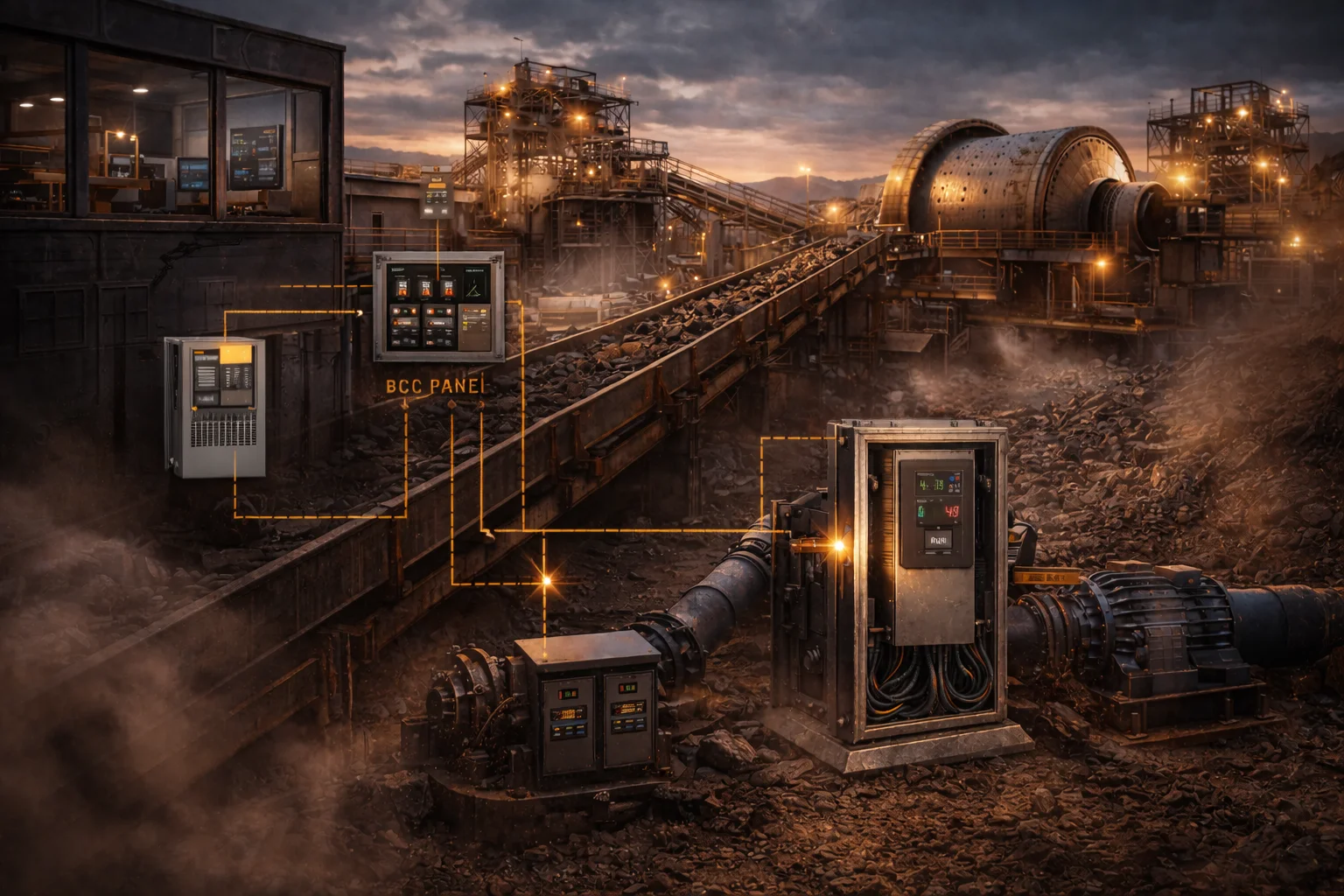
A typical mining engine control architecture is usually organized into four technical layers:
Power Layer
MV/LV power supply, transformation, protections and power quality.
Drive Layer
VFD, control parameterization, motor protections and communications.
Process Layer
Sensors, control loops, operating sequences and interlock logic.
Management Layer
SCADA, history, alarms, efficiency and maintenance indicators.
This architecture allows scaling from one-off projects to staged modernizations, with technical traceability and lower risk of plant interruptions.
Key Technical Challenges
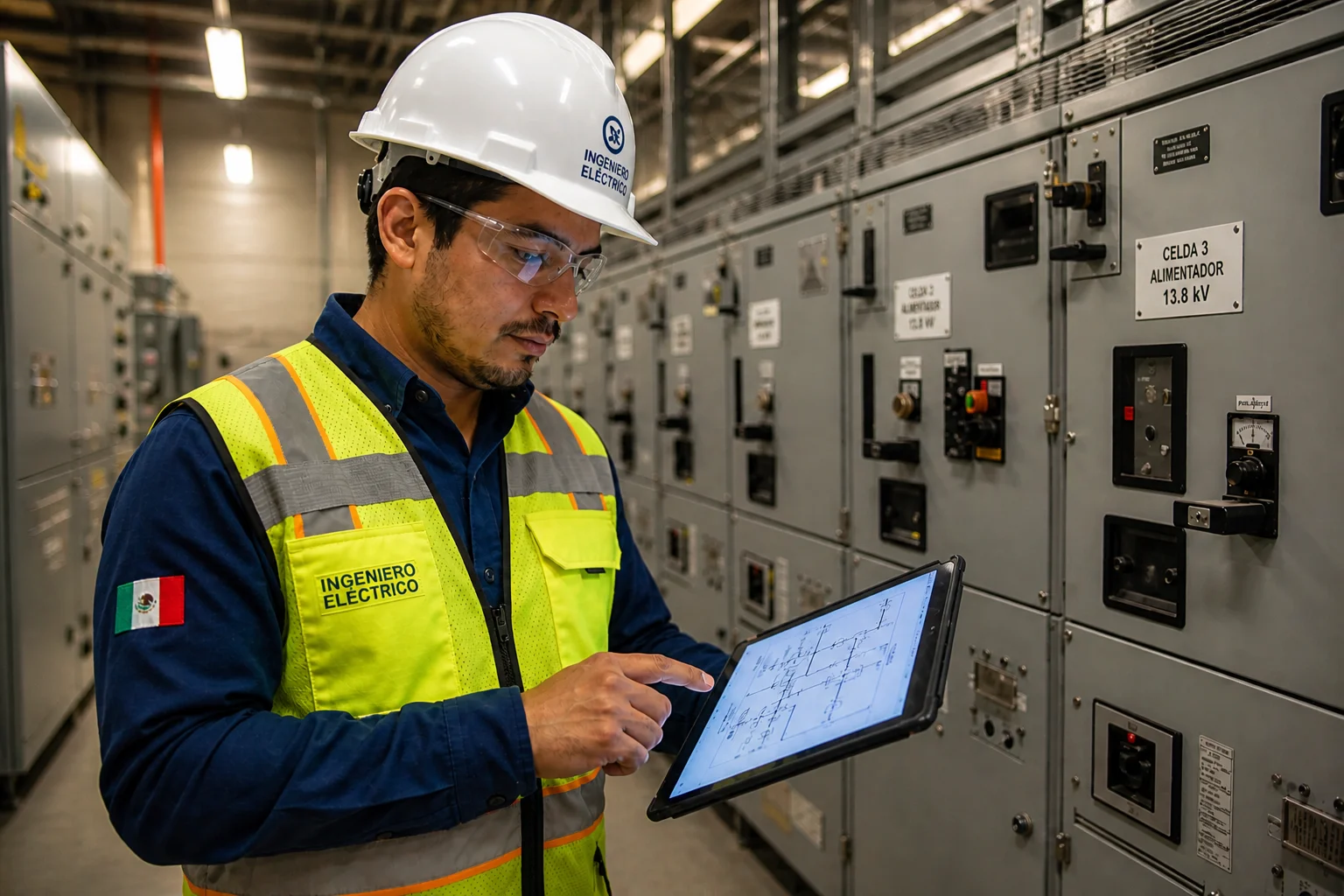
The mining industry presents operating conditions where technical margins are narrow. These are the most frequent challenges in mining variable frequency drive projects:
- High torque at low speed: requires stable control and power reserve during transitory periods.
- Demanding starts: torque and current peaks can destabilize the internal network if the ramp strategy is not well designed.
- Altitude and derating: Lower air density reduces cooling and affects system performance.
- Aggressive environment: conductive dust and vibration accelerate failures if there is no adequate protection and maintenance.
- Automation integration: without good coordination between mic, pccs and protections appear kerp and unwanted stoppages.
The most effective way to mitigate these risks is to perform pre-application engineering, integration testing and commissioning with performance criteria defined from the beginning.
Common Mistakes and How to Avoid Them
- Select by rated power and not by load profile: causes unstable performance and overheating.
- Ignore site altitude: leads to insufficient Threadings in cooling and insulation.
- Do not consider harmonics or power quality: affects protections and equipment upstream/downward.
- Surface commissioning: poorly adjusted parameters generate frequent dingh.
- No maintenance plan and spare parts: increases recovery times from failure.
Avoiding these points in the design phase significantly reduces the cost of non-quality in the operational phase.
Mini Reference Case
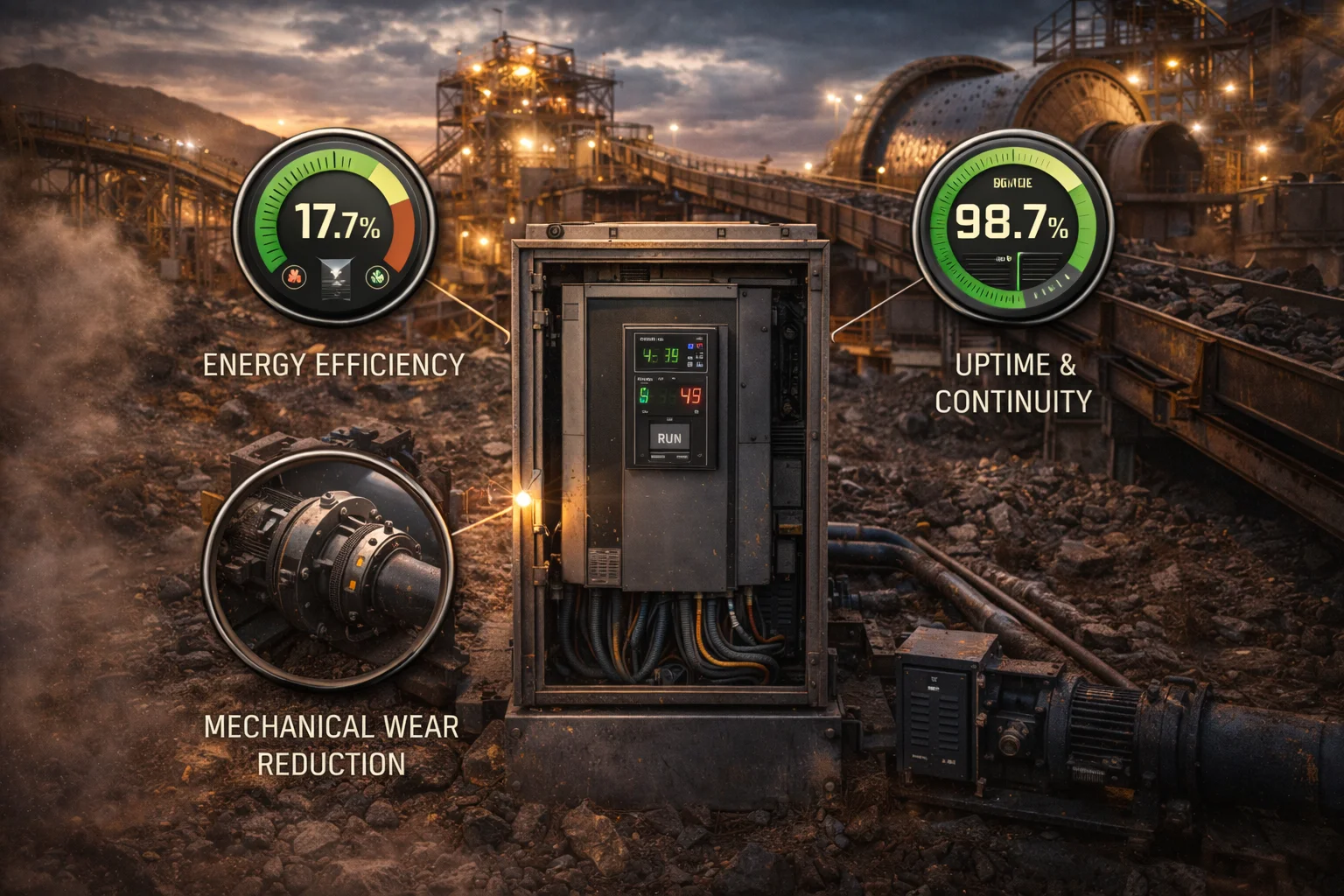
Typical scenario for optimizing drives in the mining process, applying selection criteria and structured commissioning:
These improvements are observed with greater consistency when the modernization of drives is accompanied by startup standards, coordinated protections, reliable instrumentation and support of specialists during start-up.
Technical FAQ
How to select a variator for high demand mining?
Load profile, starting torque, environmental conditions, altitude, control strategy and overload margin of the complete system must be evaluated.
Does altitude affect the performance of the variator?
Yes. At higher altitude, air cooling capacity decreases and may require CARD, cabinet settings and insulation validation.
What main benefit does a well-implemented VFD deliver?
Improves operational stability, reduces energy consumption in variable applications and protects equipment through controlled starts/stops.
When should a prior technical evaluation be carried out?
Whenever there are critical loads, unemployment history, high consumption or plans for the modernisation of on-site drives.
You want to evaluate your mining variable frequency drives?
We help you define architecture, specification and implementation path to improve continuity and efficiency of your operation.