
Maintenance and Repair of HV, MV, and LV Electrical Substations in Mexico
Technical guide to planning inspections, testing, and repairs that sustain your plant's electrical reliability — from low voltage through 69 kV and above.
Why Substation Maintenance Is Your Plant's Most Profitable Asset
In Mexican industrial operations — cement, mining, food and beverage, oil & gas, and heavy manufacturing — the substation is the bottleneck between the grid and everything else. If it fails, a single piece of equipment does not fail: the plant fails. Well-planned maintenance is not a recurring expense; it is the least expensive way to secure operational continuity.
This guide explains how to plan, perform, and standardize the maintenance of low-, medium-, and high-voltage substations in Mexico: maintenance types, required electrical tests, applicable codes, typical frequencies, and an actual 69 kV major-maintenance project at a cement plant. At the end, you will find a downloadable annual checklist that you can use as a foundation for your own plan.
1. What Is Included in HV, MV, and LV Substation Maintenance?
In Mexican practice, three voltage levels are used: baja tensión (BT) hasta 1 kV, media tensión (MT) between 1 and 35 kV (including 13.8 and 23 kV, the most common industrial levels), and alta tensión (AT) above 35 kV (69, 115, and 138 kV for CFE interconnections). Each level imposes different requirements for insulation, clearances, protection, and safety procedures.
Maintenance covers all active and passive components of the substation. It is not just a matter of “cleaning and tightening”:
- Transformadores de potencia: oil, windings, bushings, tap changer, and cooling systems.
- Interruptores de potencia: operating mechanism, interrupting chambers (SF6, vacuum, or oil), and main and arcing contacts.
- Seccionadores y cuchillas: contactos, mecanismos, alineación.
- Instrument Transformers (CTs and VTs): aislamiento, relación y polaridad.
- Protection Systems and Relays: settings verification and primary and secondary functional testing.
- Control and SCADA Systems: signal integrity, communications, and time synchronization.
- AC/DC Auxiliary Services: banco de baterías, cargadores, distribución auxiliar.
- Grounding Grid and Surge Arresters: resistividad, continuidad, integridad de conexiones equipotenciales.
- Obra civil y estructuras: supports, foundations, drainage, and access control.
If you want to understand how a substation is designed in layers — power, protection, control, and communications — before planning its maintenance, see our substation modernization guide which provides a detailed explanation of the NSIC model.
2. Maintenance Types: Predictive, Preventive, and Corrective
The three approaches are not alternatives — they are complementary and must coexist in a mature plan. The difference lies in how much OPEX they absorb and how much residual risk they leave.
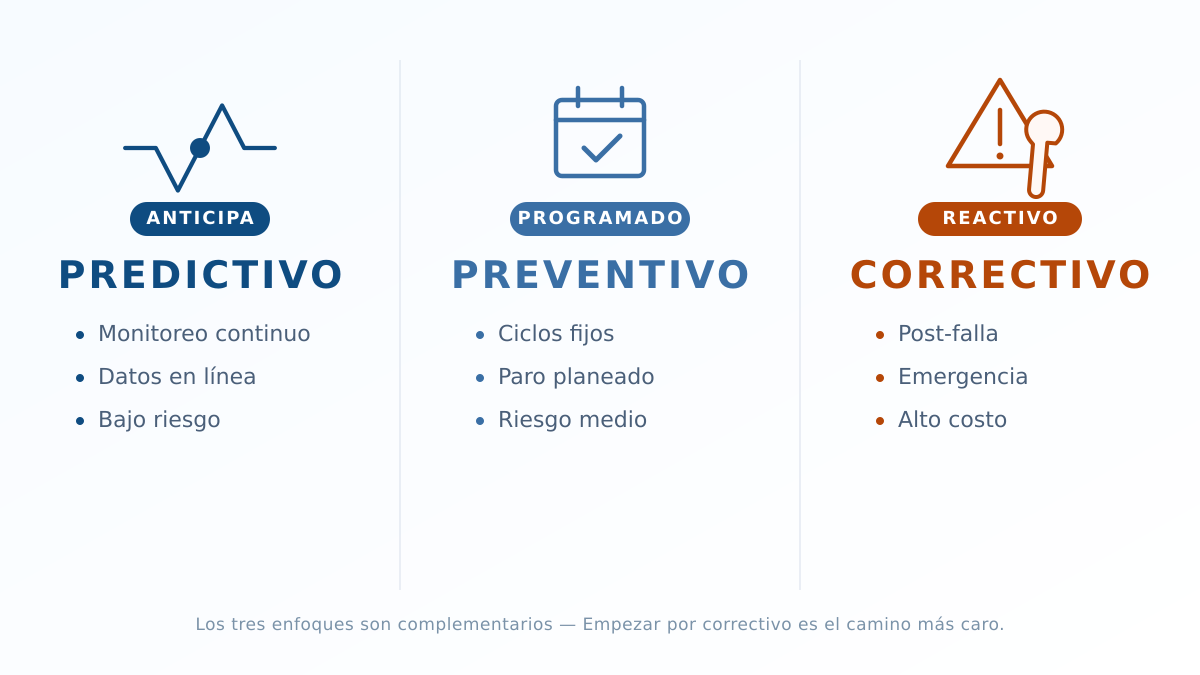
| Enfoque | Cuándo aplica | Data / Tools | Frecuencia típica | Riesgo residual |
|---|---|---|---|---|
| Predictivo | Operación normal, sin paro. | Thermography, online monitoring, oil analysis (DGA), and partial discharge testing. | Continuo o trimestral. | Low — anticipates failures before they escalate. |
| Preventivo | Paro programado planeado. | Pruebas eléctricas, inspección visual, reapriete, lubricación, calibración. | Anual a bianual. | Medium — depends on routine quality. |
| Correctivo | After an in-service failure. | Root-cause diagnosis, spare parts, repair, or replacement. | Ad-hoc. | Alto — más caro, más lento, más riesgoso. |
A common mistake is to perform only preventive maintenance “because it has always been done that way” without implementing predictive tools. A semiannual thermography survey costing USD 2,000 can detect a hot spot and prevent an USD 800,000 transformer fire plus three weeks of downtime.
3. Pruebas eléctricas clave
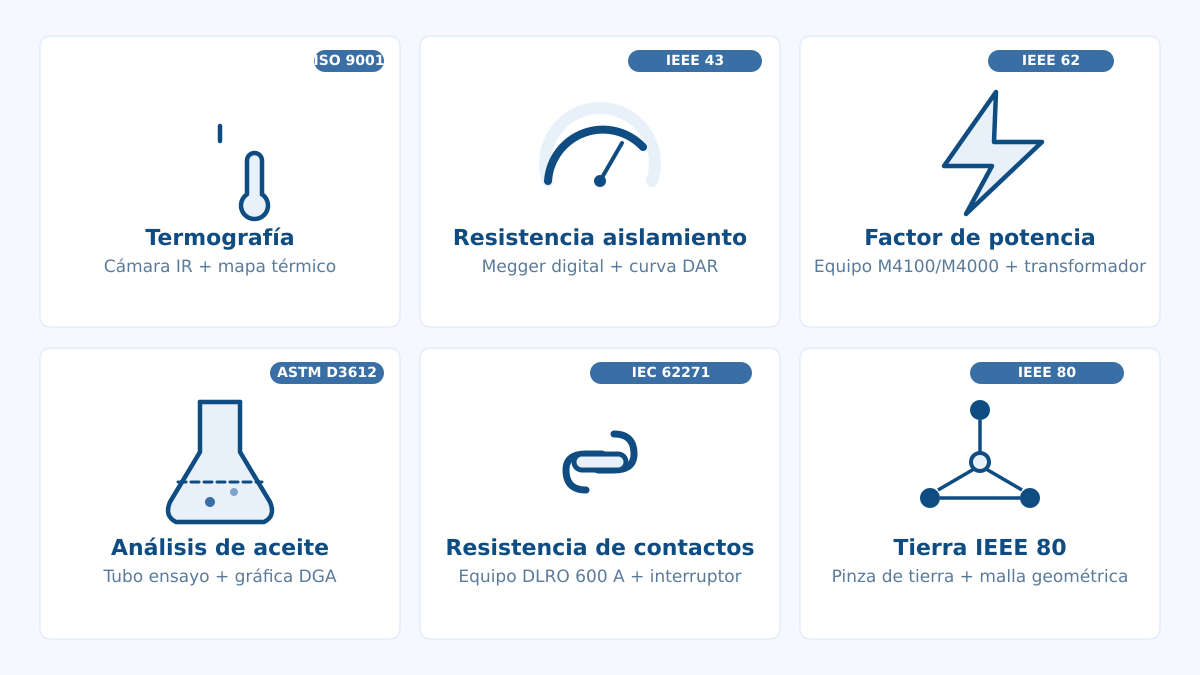
These are the tests that any serious industrial-substation maintenance plan should include. The first three are non-invasive (predictive); the remaining tests require de-energized equipment.
Termografía infrarroja
Thermal-camera inspection of in-service busbars, connections, bushings, and mechanisms. It detects hot spots caused by loose connections, corrosion, or overload before they escalate into failures. This test has the best cost-benefit ratio in the portfolio.
Insulation resistance (megger) and dielectric absorption
Measures the integrity of solid insulation in transformers, cables, and motors by applying DC voltage. The polarization index (PI) and dielectric absorption ratio (DAR) indicate moisture or insulation contamination.
Power Factor and Tan Delta
Used on power transformers, bushings, and cables. It detects insulation aging caused by moisture, contamination, or thermal degradation. A rising trend over successive measurements is an early warning of lost useful life.
Physical-chemical and dielectric analysis of oil
Transformer oil is a silent witness to the unit’s internal condition. Chromatographic dissolved gas analysis (DGA) can detect arcing, partial discharge, or overheating of paper and oil. Dielectric breakdown voltage (BDV), moisture, acidity, and interfacial-tension tests complete the assessment.
Circuit-Breaker Contact Resistance (DLRO)
Measures voltage drop using a high DC test current (100−600 A) across the main contacts of circuit breakers and disconnect switches. Abnormal resistance indicates wear, oxidation, or insufficient contact pressure — precursors to overheating and arcing.
Grounding Measurements and Grid Continuity
Verifies the effectiveness of the substation grounding system. A degraded grid is an invisible safety risk: step and touch voltages can become lethal without warning. Soil resistivity, grid resistance, and continuity of equipotential connections are measured.
| Prueba | Qué detecta | Norma de referencia | Frecuencia recomendada |
|---|---|---|---|
| Termografía | Puntos calientes, mal apriete, sobrecarga. | NETA MTS, ASTM E1934 | Semestral |
| Resistencia de aislamiento | Humedad, contaminación, degradación. | IEEE 43, IEC 60270 | Anual |
| Factor de potencia / tan-delta | Envejecimiento del aislamiento. | IEEE C57.152 | Anual a bianual |
| Análisis de aceite (DGA + FQ) | Arcos, descargas, sobrecalentamiento. | NMX-J-169-ANCE, IEEE C57.106, IEC 60422 | Anual (semestral en críticos) |
| Resistencia de contactos (DLRO) | Desgaste, oxidación. | IEC 62271 | Anual a bianual |
| Grounding System | Step/touch voltage, continuity. | IEEE 80, IEEE 81, NOM-001-SEDE | Bianual |
4. Normativa aplicable en México
The regulatory framework for industrial electrical maintenance in Mexico combines mandatory Mexican NOM standards and internationally recognized standards adopted by industry:
- NOM-001-SEDE-2012 — Electrical utilization installations. Mandatory general framework for every industrial installation in Mexico.
- NOM-029-STPS-2011 — Maintenance of electrical installations in workplaces. Employer obligations for safe operation and maintenance.
- NMX-J-169-ANCE — Test methods for distribution and power transformers.
- IEEE 62 / IEEE C57.152 — Diagnostic guides for liquid-immersed transformers, widely adopted across industry.
- IEC 60076 — Specifications for power transformers.
- IEC 60270 — Techniques for measuring partial discharges in insulation.
- CFE-G0000-62 and PEMEX NRF standards when applicable to the customer.
- NFPA 70E — Electrical safety in the workplace, arc-flash analysis, and PPE categories 1–4.
For industrial customers, the key is not memorizing the list — it is requiring the maintenance provider to deliver documented evidence of compliance with each standard. A professional report includes signed test protocols, calibration certificates for test equipment, and a standards-based technical assessment.
5. Frecuencias recomendadas y plan anual
The annual plan should combine frequent brief inspections with major interventions at longer intervals. A reference matrix for 13.8−69 kV industrial substations in Mexico:
| Equipment | Inspección visual | Pruebas eléctricas | Major maintenance |
|---|---|---|---|
| Transformador de potencia | Mensual | DGA semestral, dieléctricas anuales | Every 6 years |
| Interruptor de potencia (SF6) | Trimestral | Annual DLRO and operating-time tests | Every 5 years or based on the number of operations |
| Seccionadores y cuchillas | Trimestral | DLRO bianual | Every 6–8 years |
| Relés de protección | N/A | Pruebas funcionales anuales | Recalibration every 4–5 years |
| Banco de baterías DC | Mensual | Conductancia y descarga anuales | Replacement every 8–12 years |
| Malla de tierra | Anual visual | Resistividad y resistencia bianuales | Refresh every 10 years |
These figures are typical industry references. Process criticality, environmental conditions (corrosive environments, altitude, temperature), and the substation’s history may justify increasing or decreasing the intervals.
6. Warning signs that your substation needs urgent repairs
If your substation shows any of these signs, do not wait for the next scheduled shutdown:
- Repeated or unexpected trips with no identifiable cause.
- Abnormal transformer noises (louder-than-usual humming or internal metallic knocks).
- Burnt-oil or insulation odor.
- Visible oil leaks from transformers, bushings, or tanks.
- Abnormal thermal readings from online monitoring or thermography.
- Active Buchholz, overpressure, or low-oil-level alarms.
- Visible overheating or discoloration on busbars and connections.
- Difficulty operating circuit breakers or disconnect switches (sticking, chattering, or operating times outside specification).
- Audible or visible partial discharges (corona effect).
- Unexplained variations in voltage, current, or power-factor readings.
Any of these conditions requires immediate corrective action by qualified personnel; do not wait for the next scheduled maintenance. The cost of delayed action rises exponentially.
7. Actual project — major maintenance of a 69 kV substation at a cement plant in Jalisco (2025)
Major maintenance of a 69 kV substation — cement plant, Jalisco
Contexto: A cement plant in Jalisco with a 69/13.8 kV substation feeding rotary kilns, mills, and auxiliary services. Its operational criticality requires every intervention to be completed within a scheduled shutdown window agreed with production months in advance.
Alcance ejecutado por VMS Energy:
- Comprehensive dielectric testing of the 69/13.8 kV power transformer: power factor, insulation resistance, physical-chemical analysis, and dissolved gas analysis (DGA) of the oil.
- Major maintenance of power circuit breakers: mechanism and contact inspection, timing tests, and DLRO resistance testing.
- Certified retightening of power connections using calibrated torque, with photographic records.
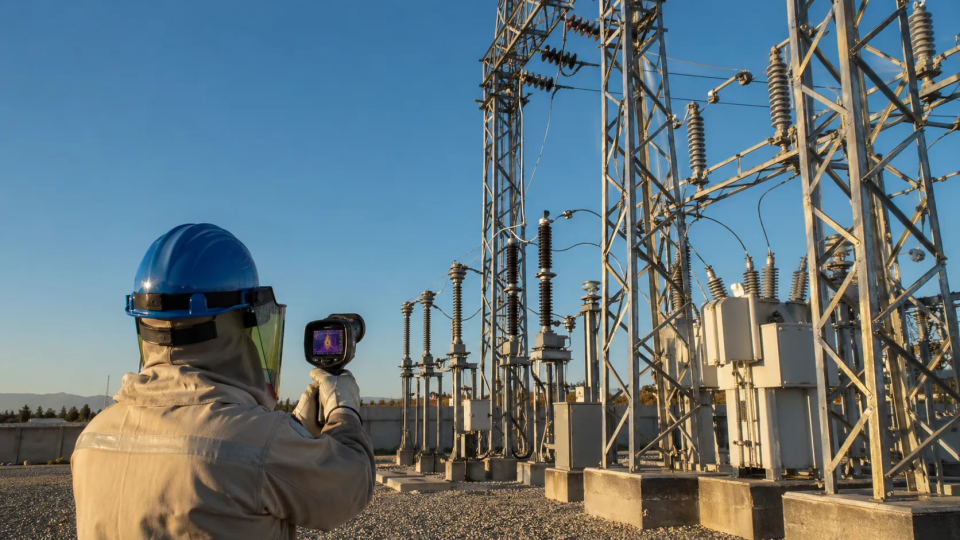
- Thermography before and after the intervention to validate the results.
- Protection verification and refresh, including relay functional tests and coordination checks.
- Inspection and measurement of the grounding grid, with an IEEE 80 compliance assessment.
- Complete documentation: signed protocols, technical assessments, and delivery of the maintenance log.
Resultado: The substation was returned to service within the planned window, with satisfactory acceptance tests and a 12-month predictive follow-up plan. The customer maintained production-line continuity and received a technical dossier suitable for ISO audits and corporate reporting.
Does your substation need an independent assessment?
We perform a technical site visit with thermography and a preliminary review to determine the actual maintenance scope your installation requires, with no obligation to hire.
8. Maintenance or modernization? How to decide
There comes a point when maintenance no longer restores useful life — it only postpones the inevitable. These are the most commonly used decision criteria:
- Edad técnica: Medium-voltage equipment with more than 35 years of service, or high-voltage equipment with more than 40 years, enters the structural-assessment zone.
- Tendencia de pruebas dieléctricas: If power-factor and DGA results show accelerating degradation over successive measurements, the insulation can no longer be restored.
- Disponibilidad de refacciones: Discontinued equipment with less than six months of global spare-parts inventory represents a growing operational risk.
- Capacidad y crecimiento: If the plant is planning an expansion, upgrading to 1.5 times the current rating avoids a second intervention within three years.
- Brechas normativas: Obsolete electromechanical protection, systems without SCADA communications, and grounding grids that cannot be certified — the cost of remediation may approach the cost of replacement.
If the assessment shows that the issue is structural — design, capacity, or obsolete protection — use our autodiagnóstico de modernización which organizes the decision in layers (NSIC) and converts technical findings into actionable CAPEX and OPEX.
9. How to choose an electrical maintenance provider
Five practical criteria for evaluating a provider before signing an annual contract:
- Certificaciones ISO vigentes: ISO 9001 (quality), 14001 (environment), 45001 (OH&S), 37001 (anti-bribery), and 50001 (energy) are baseline requirements, not bonuses.
- Calibrated and traceable test equipment: Require valid calibration certificates traceable to national standards (CENAM or equivalent).
- Capacidad multimarca: The provider should be able to service ABB, Siemens, Schneider, GE, Hitachi, and similar equipment without locking you into a single manufacturer.
- Documented experience in your industry: Verifiable references in cement, mining, food processing, or the sector relevant to your operation.
- Capacidad EPC integral: If the assessment shows that you need modernization, choose a provider capable of delivering engineering, procurement, and construction — instead of handing the project off among three different contractors.
10. Checklist anual descargable
Annual inspection checklist — HV, MV, and LV substations
Printable template with 12 sections and more than 80 verification points, aligned with NOM-001-SEDE-2012, NOM-029-STPS-2011, and IEEE/IEC best practices. Use it as the basis for your plan or as an audit worksheet for your current provider.
11. Preguntas frecuentes
How often should an industrial substation be maintained?
A typical schedule includes monthly or quarterly visual inspections, major electrical testing every 12 to 24 months, and major maintenance during a scheduled shutdown every 4 to 6 years. The exact plan depends on process criticality, voltage levels, and predictive-analysis results.
What is the difference between preventive, predictive, and corrective maintenance?
Predictive maintenance uses data and continuous monitoring to anticipate failures. Preventive maintenance follows a schedule of periodic inspections and tests. Corrective maintenance intervenes after a failure has occurred. The logical order for minimizing OPEX is predictive first, then preventive, with corrective work reserved for emergencies.
Which electrical tests are required for substations in Mexico?
NOM-001-SEDE-2012 and NOM-029-STPS-2011 establish the general framework. In industrial practice, required tests include thermography, insulation resistance, power factor, dielectric-oil analysis (NMX-J-169-ANCE), and circuit-breaker contact resistance.
Can maintenance be performed without stopping operations?
Predictive inspections such as thermography, partial-discharge analysis, and online monitoring are performed while the substation is energized. Major electrical tests and work on transformers and circuit breakers require a scheduled shutdown and safe lockout/tagout (LOTO).
How much downtime does major maintenance require?
Major maintenance of a 13.8 to 69 kV substation typically requires 24 to 72 hours of scheduled downtime, depending on the scope, number of bays, and whether the power transformer is included. Planning with the customer is critical to minimizing the outage window.
Which standard covers transformer dielectric oil?
NMX-J-169-ANCE defines test methods for mineral insulating oil. IEEE C57.106 and IEC 60422 are the most widely used international references for acceptance criteria and dissolved gas analysis (DGA).
Is an annual maintenance contract better than event-based service?
For critical processes, an annual contract with a predictive and preventive plan is more economical than event-based service. Event-based service is suitable only for low-criticality secondary installations or when a near-term modernization plan will make the current equipment obsolete.
Transformer maintenance or replacement?
If dielectric testing, oil analysis, and thermography indicate structural insulation degradation, maintenance can no longer restore useful life and modernization should be evaluated. The modernization guide and self-assessment help you decide between intervention and replacement.
Related services
Ready to plan the maintenance your substation needs?
VMS Energy offers everything from targeted assessments to annual contracts with predictive and preventive plans and 24/7 emergency response. Nationwide coverage from Guadalajara and Ciudad del Carmen.
Annual inspection checklist — HV, MV, and LV electrical substations
Reference template for the annual inspection and maintenance of industrial substations. Aligned with NOM-001-SEDE-2012, NOM-029-STPS-2011, IEEE C57, IEEE 80, and industry best practices. This template does not replace a formal protocol performed with calibrated test equipment — it is a roadmap for planning and auditing.
0. General information
Cómo usar: Check each completed item. Record the measured value where applicable. For items with deviations, add a note in Section 11 (Findings). EPP: Perform an arc-flash analysis and use the corresponding NFPA 70E PPE category before beginning.
1. Inspección visual general del recinto
2. Transformador de potencia NMX-J-169-ANCE · IEEE C57.152
Inspección visual y mecánica
Electrical and analytical tests
3. Interruptores de potencia IEC 62271
4. Seccionadores y cuchillas
5. Instrument transformers (CTs and VTs)
6. Protection systems and relays NOM-001-SEDE
7. DC auxiliary services and battery bank
8. AC auxiliary services
9. Grounding grid and surge arresters IEEE 80 · IEEE 81
10. SCADA, communications, and thermography
11. Hallazgos, desviaciones y recomendaciones
List items found outside specification, including severity (High / Medium / Low) and the recommended remediation deadline.