
Variable Frequency Drives in the Mining Industry
A technical guide to selecting, sizing, and operating variable frequency drives in mining, with a focus on continuity, safety, and energy efficiency.
Article index
Resumen Ejecutivo
Los variable frequency drives in mining (VFDs for mining, or mining drives) have become one of the technical levers with the greatest impact on operational continuity, energy efficiency, and process control. In extraction, crushing, grinding, pumping, and ventilation operations, controlling speed, torque, and acceleration ramps can mean the difference between a stable line and a plant with frequent shutdowns.
When evaluating a motor control in mining, the drive should not be treated as an isolated device. It must be analyzed as part of a complete electrical architecture: motor, mechanical load, power network, protection, environment, control strategy, and maintenance. This integrated view is essential to avoid costly oversizing or undersizing that compromises reliability.
In mining, operating demands are particularly high: constant-torque loads, overload peaks, heavily loaded electrical networks, dust, vibration, and high-altitude locations. Therefore, variadores para bandas transportadorasconveyors, pumps, fans, and mills require much more robust technical specification criteria than conventional industrial applications.
This article summarizes how to select and apply VFDs in mining using a practical approach: where they generate the most value, which selection criteria to use, what typical architecture is most suitable, the most common mistakes, and how to structure an implementation roadmap that improves availability and reduces total operating cost.
Mining Applications Where VFDs Deliver the Greatest Value

Variable frequency drives deliver the greatest return when applied to variable loads, controlled ramps, and high-availability requirements. In practice, the applications with the best technical and economic potential are usually:
- Bandas transportadoras: Drives for conveyor belts reduce mechanical stress during startup, minimize slippage, and improve synchronization between sections.
- Process and dewatering pumps: They adjust flow and pressure to actual demand, reducing energy consumption and hydraulic shock.
- Main and auxiliary ventilation: enable precise airflow control, which is essential for safety and compliance with working conditions.
- Milling and crushing: They improve low-speed torque control, especially during startup sequences and transient operation.
- Critical auxiliary systems: Such as agitators, filtration, or tailings pumping, where dynamic control protects equipment and maintains process quality.
In all these cases, a sound mining drives help reduce current peaks, stabilize the plant’s internal network, and protect mechanical assets. The result is not only energy savings, but also greater reliability, less corrective maintenance, and more predictable operations.
Drive Selection Criteria for Mining
Selecting the right drive for the mining industry requires a technical decision matrix, not merely a comparison of rated power. Recommended criteria include:
- Perfil de carga real: constant, variable, or mixed torque; start/stop cycles; overload duration.
- VFD Overload Capacity: especially critical for high-inertia mills and conveyors.
- Control Strategy: Scalar, vector, or advanced control, depending on the required precision and dynamics.
- Condiciones ambientales: Dust, temperature, humidity, vibration, and contamination level.
- Site Altitude: consider derating, cooling, and insulation for operations 2,000–4,000 meters above sea level.
- Power quality: Harmonics, power factor, filters, and compatibility with the grid and transformer.
- Mantenibilidad: Access to spare parts, remote diagnostics, parameter configuration, and field support.
From a energy efficiency in mining, the best projects integrate equipment selection, control strategy, and commissioning into a single roadmap. Without this integration, expected performance often fails to materialize in actual operation.
Typical Drive Architecture in Mining
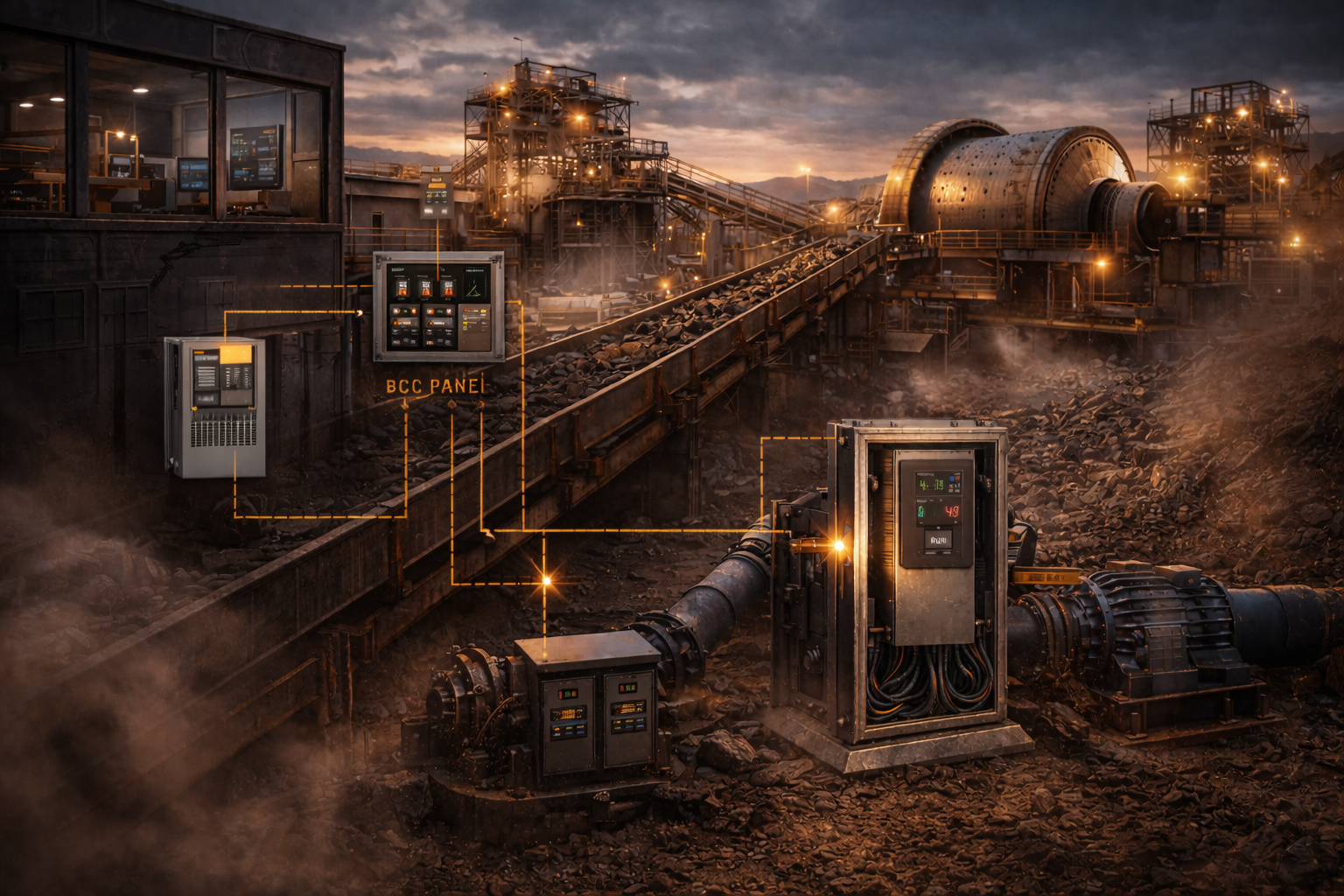
A typical motor-control architecture for mining is usually organized into four technical layers:
Capa de Potencia
MV/LV supply, transformation, protection, and power quality.
Capa de Accionamiento
VFD, control parameterization, motor protection, and communications.
Capa de Proceso
Sensors, control loops, operating sequences, and interlock logic.
Management Layer
SCADA, historical data, alarms, efficiency indicators, and maintenance.
This architecture supports scaling from targeted projects to phased modernization, with technical traceability and a lower risk of plant interruptions.
Key Technical Challenges

The mining industry presents operating conditions with narrow technical margins. These are the most common challenges in mining variable-frequency-drive projects:
- Par elevado a baja velocidad: requires stable control and current reserve during transients.
- Arranques exigentes: torque and current peaks can destabilize the internal grid if the ramp strategy is not properly designed.
- Altitud y derating: lower air density reduces cooling and affects system performance.
- Ambiente agresivo: Conductive dust and vibration accelerate failures without adequate protection and maintenance.
- Automation integration: Poor coordination among the drive, PLC, and protection causes unwanted trips and shutdowns.
The most effective way to mitigate these risks is to conduct application engineering in advance, perform integration tests, and commission the system using performance criteria defined from the outset.
Common Mistakes and How to Avoid Them
- Selecting by rated power rather than load profile: causes unstable performance and overheating.
- Ignoring Site Altitude: leads to inadequate cooling and insulation sizing.
- Failing to consider harmonics and power quality: affects protection devices and upstream/downstream equipment.
- Comisionamiento superficial: Incorrectly adjusted parameters cause frequent trips.
- No Maintenance and Spare-Parts Plan: increases recovery time after a failure.
Avoiding these issues during the design phase significantly reduces the cost of poor quality during operation.
Mini Caso de Referencia
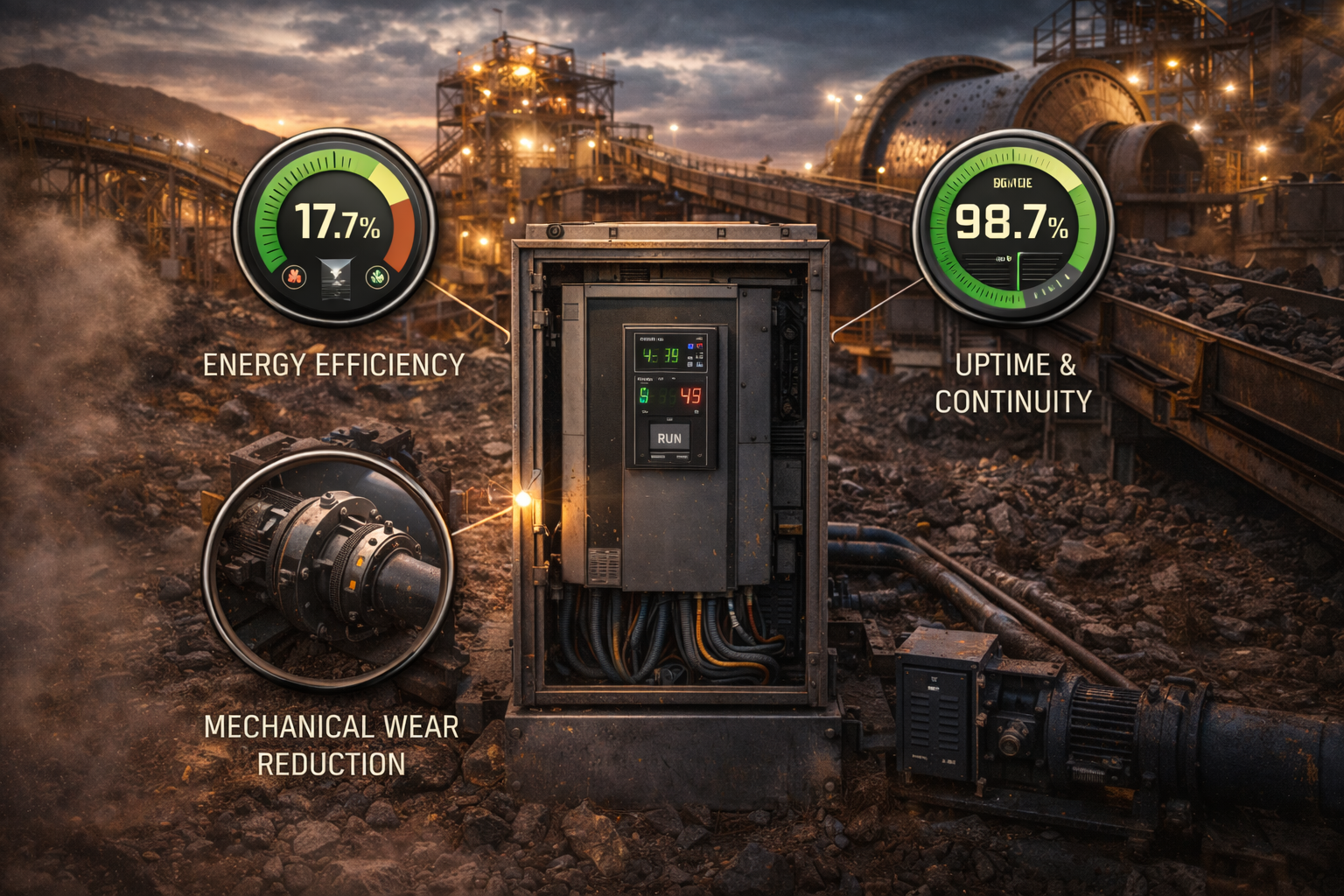
Typical drive-optimization scenario in a mining process using sound selection criteria and structured commissioning:
These improvements are most consistent when drive modernization is accompanied by startup standards, coordinated protection, reliable instrumentation, and specialist support during commissioning.
Technical FAQ
How do you select a drive for demanding mining applications?
The load profile, starting torque, environmental conditions, altitude, control strategy, and overload margin of the complete system must be evaluated.
Does altitude affect drive performance?
Yes. At higher altitudes, the air’s cooling capacity decreases and may require derating, enclosure modifications, and insulation validation.
What is the main benefit of a properly implemented VFD?
It improves operational stability, reduces energy consumption in variable applications, and protects equipment through controlled starts and stops.
When is a prior technical assessment advisable?
Whenever there are critical loads, a history of shutdowns, high energy consumption, or plans to modernize plant drives.
Would you like to evaluate your mining drives?
We help you define the architecture, specifications, and implementation roadmap to improve the continuity and efficiency of your operation.