Anti-Bribery Policy [Discipline: QHSE+]
Establish moral and ethical standards that allow prohibiting, preventing, detecting and punishing all types of acts of bribery; guaranteeing transparency with collaborators and interested parties, fully complying with the applicable requirements, thus promoting the continuous improvement of the organization.
Conduct that violates the anti-bribery policy must be reported to the ethics committee, which will be subject to their respective administrative disciplinary, civil and/or criminal sanctions.
Reports made in good faith or based on reasonable belief will be protected under the confidentiality of information without risk of retaliation.
1. General Obligations of VMS ENERGY Employees and Stakeholders: In compliance with this document, collaborators and interested parties have the obligation:
- a) Report to the competent authority and through the defined communication channels, queries, complaints and reports about acts or possible acts of bribery; as well as non-compliance with the established anti-bribery policy.
- b) Demonstrate commitment to the company to ensure compliance with the anti-bribery policy and the requirements of the anti-bribery management system.
- c) Understand and raise awareness regarding the importance of their daily activities and responsibilities, to contribute to compliance with the anti-bribery policy.
2. Obligations of the personnel in charge of investigating and processing complaints: To maintain an anti-bribery management system that fosters a culture of detection and action in cases of bribery, the personnel in charge of investigating and handling complaints must:
- a) Promote the submission of queries, complaints and reports in good faith, regarding acts or possible acts of bribery, in confidence and without fear of reprisals.
- b) Save and reserve the facts that are known in the investigative process and when it is information subject to confidentiality, use it only for the purposes provided for by law.
- c) Ensure the mitigation and elimination of the risk of retaliation against workers and interested parties who report, in good faith, acts or possible acts of bribery; as well as non-compliance with the established anti-bribery policy.
- d) Ensure the non-admission of false, reckless or bad faith complaints.
3. Prohibitions on personnel: In compliance with this document, VMS ENERGY workers and interested parties are totally prohibited from:
- a) Offer or give, directly or indirectly, gifts, invitations, hospitality, displays of hospitality or the equivalent in money to any Client, suppliers, users or third parties, with the purpose of seeking influence or an effect on a company process, or if it is expected that the favor must be returned seeking to gain an improper advantage.
- b) Directly or indirectly accept gifts, invitations, hospitality, displays of hospitality or the equivalent in money from any supplier, users or third parties, in order to gain an improper advantage or that may otherwise give rise to a conflict of interest.
- c) Involve in any way in an act or possible act of bribery, either directly or through a third party; as well as, inducing a person to act illegally or inappropriately.
- d) Hide, change, omit records to conceal improper activities.
- e) Ignore or fail to report to the relevant authorities any sign that acts or possible acts of bribery have been carried out in the institution.
- f) Direct or indirect participation in any tender that shows signs of corruption is prohibited, reporting any fact through the reporting channels.
4. Critical Control Points:
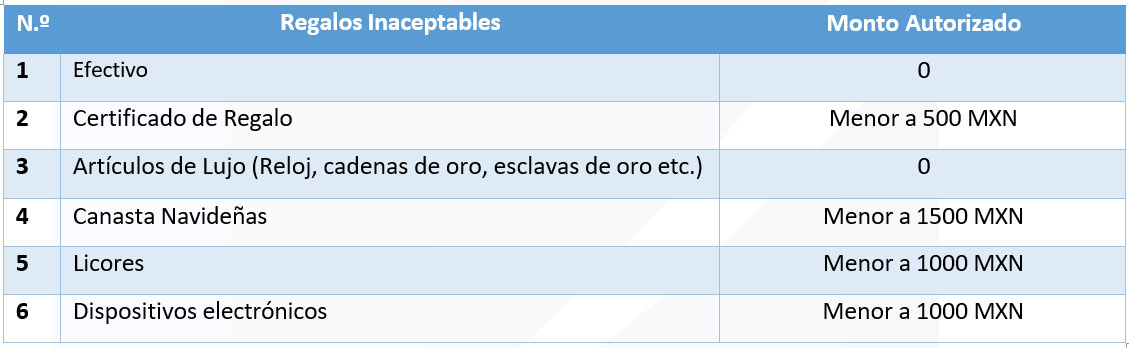
- a) When unacceptable gifts are received within the established monetary thresholds, they must be delivered to the Human Resources department so they can be raffled among VMS ENERGY personnel at an event organized by the department.
ACCEPTABLE GIFTS MAY INCLUDE:
◆ Promotional items such as pens, notebooks, mugs, tumblers, backpacks, etc.
◆ Seasonal greeting cards.
LOS REGALOS INACEPTABLES:
B) Meal invitations extended to stakeholders must be authorized by Executive Management in the annual budget.
C) When services or visits are performed in areas controlled by groups that request a facilitation payment for passage, the action must be authorized by Management.